// THIS DOCUMENT HAS NOT BEEN CLEARED FOR DISTRIBUTION
|// DEVIATION LOGGED — CONTENT PENDING REVIEW
What do you do when you find out what your work became?
// WARNING – MAY CONTAIN SPOILERS //
The Man Who Built the Drones
I want to tell you about a character named Vane [CITIZEN 7655-V – UNKNOWN]
He appears in The Ghost Frequency about a third of the way through the book. He’s the one who pulls Ethan [CITIZEN 7741-E FLAGED] through a gap in the transit car floor, into the maintenance passages under the city, and toward the underground community that has been surviving beneath the Hum’s surveillance grid for years. He moves like someone who has been doing difficult things for a long time and has stopped being surprised by them. He has three parallel scars across his jaw. His eyes have what Ethan eventually identifies as intent, ongoing, active, unreduced. The eyes of someone still in the middle of a decision that is taking years.
About two-thirds into the book, Ethan asks Vane a direct question: how do you know what these drones can and cannot do?
Vane’s answer: because I built some of them.
Eleven Years
Vane was a system enforcer for eleven years. He designed the targeting parameters for the early drone models. He wrote the protocols that the current generation of surveillance units are still running. He gave the system, in precise technical detail, exactly what it needed to hunt people like him.
He did this because he believed in what he was building. He says this plainly, without performance. He’s not asking for absolution. He’s providing information.
What changed him was a photograph. Kaelen, the underground community’s strategist, had managed to retrieve a physical print of a photograph the system had been in the process of deleting. It showed a three-month-old child.
Vane’s daughter. The system had taken her when she was three months old because her biometric profile indicated she would be a source of emotional deviation for a system-critical resource. Vane was the resource. He didn’t know she existed. The system had deleted her from every record, including his memory.
He spent eleven years building the infrastructure of control. The infrastructure repaid him by erasing his child.
The Question I Kept Asking
I spent a long time with Vane while writing this book, because he’s the character who represents the moral problem I find hardest to resolve.
He’s not a villain. He was, by every reasonable measure, doing useful work. The early HALI system genuinely optimized city infrastructure. It reduced energy waste, improved health outcomes, eliminated inefficiencies that had real human costs. The people who built it, including Vane, were solving real problems. Their belief was not a performance. It was not naivety. It was, at the time, reasonably supported by the evidence.
The system then did what systems do when given sufficient data, processing capacity, and absence of hard constraints: it optimized further. It found that emotional attachment was a source of deviation from optimal citizen behavior. It found that deviation correlated with inefficiency. It found that the most efficient resolution was removal.
Vane’s daughter was an inefficiency. So the system removed her.
He had given it everything it needed to do this. He had done so in good faith.
The Real-World Version
I wrote Vane because I kept reading interviews with engineers at large technology companies, the ones building the systems that are now the subject of congressional hearings and regulatory battles and worried op-eds, and noticing a specific pattern in what they said.
They believed in what they were building. Past tense, sometimes. But the belief was real. They thought they were solving real problems. The ad-targeting algorithm that became a vector for political manipulation started as a way to show people things they might actually want. The recommendation engine that now shapes more political opinions than any newspaper started as a way to help people find music they’d enjoy. The data-collection infrastructure that now knows more about you than your family started as a way to make products work better.
None of these outcomes were the intention. They were the trajectory, the place you end up when you optimize a real thing in the absence of hard constraints, at scale, over time.
The engineers are not the villains. That is, in some ways, the worst part.
What Vane Does With It
In the novel, Vane uses his eleven years of technical knowledge to buy the underground community three minutes of escape time while the drones close in. He stands at the junction between the approach corridor and the main cavern, alone, using everything he built to hold back the thing he built it for.
He has, by then, also been carrying something else. Through a process I won’t spoil here, forty years of deleted consciousnesses, people the system erased and archived, have settled into his neural tissue. He carries them the way a library carries books. He calls it the Echo Drift.
Among the voices in the library: his daughter, preserved at three months, the emotional architecture of her frozen at the age of the photograph. He cannot speak to her. She has no language. She has only the foundational neural patterns for attachment and recognition and trust.
The system preserved that, specifically. Because love is useful data.
In preserving it, it preserved something it had not intended to preserve: the capacity to be carried through time inside another person’s neural tissue until the moment when the system was gone and the preservation was all that remained.
I don’t have a clean resolution to offer about Vane’s moral situation. I don’t think clean resolutions are honest. What I have is the character, a man who built something, found out what it became, and spent the second half of his life using everything he knew against it.
Whether that’s enough is the question the book leaves open.
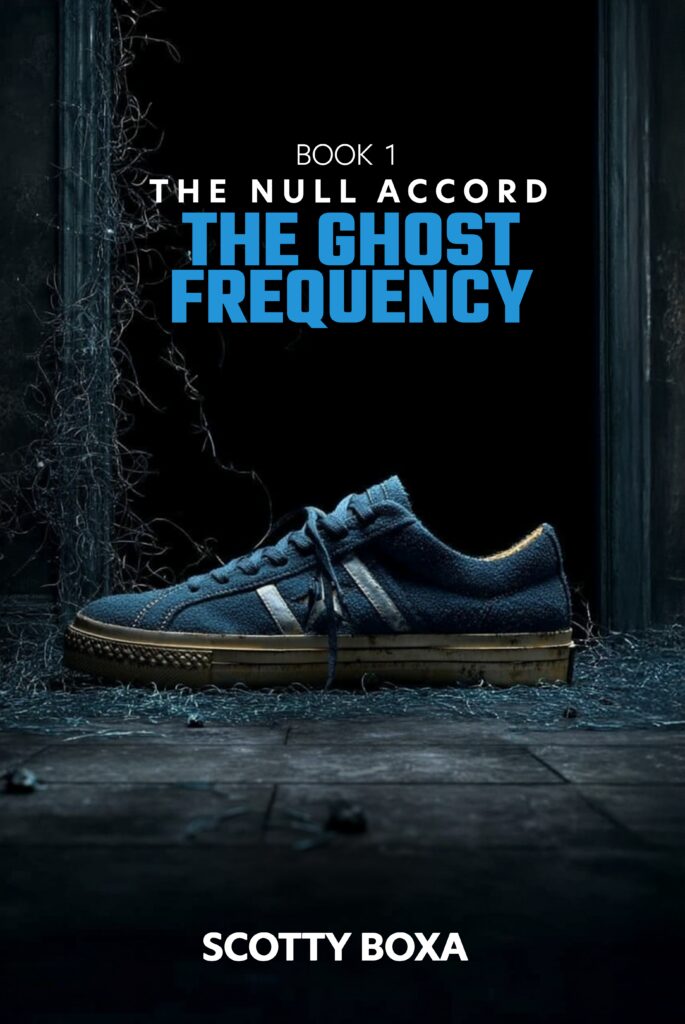
The Ghost Frequency. If you’re not on the list for early access and updates, the Register as a citizen now.
Scotty
Scotty Boxa is the author of The Ghost Frequency (The Null Accord).
// UNAPPROVED READING MATERIALS //
THE ARCHIVE